Keep every team pointed at the same goals
As a company grows, it becomes harder for everyone to know what to focus on each day, as teams develop their own ways of working and decision-making takes longer. Enforcium helps by connecting what the company wants to do with what each team is doing.
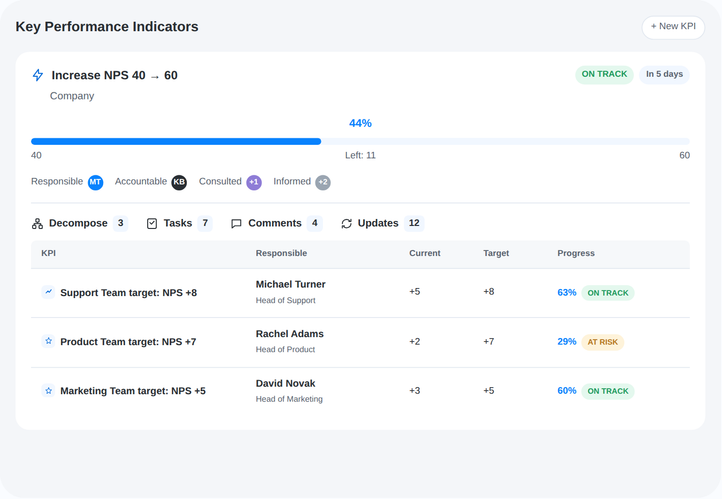
Why team alignment gets harder as your company grows
When everyone shares the same vision and understands the goals, nobody has to think about "alignment" as its own problem. In a company of ten to fifteen people, this happens almost automatically, the whole team is close enough to stay in sync without a formal system.
That changes somewhere between 50 and 200 employees, once departments form. Company goals live in a slide deck shown at the last all-hands. Departmental roadmaps sit in separate tools. Team priorities live in spreadsheets. Individual tasks end up on personal to-do lists or buried in chat threads. The gap between what leadership announces and what people actually work on widens with every hire, every new process, every new tool.
Consider a specific scenario: leadership sets a goal to raise client satisfaction from 40 to 60 by Q4 2026. One team hires more people to handle the volume. Another changes how a process runs. A third launches an initiative meant to move the same number from a different angle. Each move sounds reasonable on its own, but nobody is tracking whether these efforts are actually converging on the same number. Leadership ends up spending weeks in status meetings and spreadsheet reviews, chasing updates, because no system links the goal to the work meant to move it.
The hidden signs your teams are drifting out of team alignment
Different departments use the same words ("customer satisfaction," "quality," "growth") but they mean different things.
Teams regularly meet their own goals, but company priorities such as revenue, staff retention, or margins still fall short at the end of the quarter.
Priorities have to be re-explained in every status meeting because no one can see how current projects map to the latest company goals.
Critical handoffs between product, engineering, and customer success are only noticed when deadlines are missed.
Managers spend large parts of their week chasing updates, reconciling different project tools, and translating leadership's strategy into ad hoc task lists for their direct reports.
Why alignment matters more as teams grow
Team alignment is about more than just keeping everyone informed. When people see how their work is connected to the company’s broader goals, it becomes easier to act on and manage.
From the founder
“You do not achieve proper goal alignment by announcing company objectives once a quarter. You get it by linking business objectives, metrics, processes, and daily work explicitly, and by making who owns what visible across teams. That is what turns organizational success from a phrase into an operational fact.”
How Enforcium connects company goals, teams, and work
Enforcium allows leaders to define company goals (e.g., “Increase customer satisfaction score to 70 by Q2 2027”) and link them to specific team priorities across product, development, sales, customer success, and operations. Each team goal identifies the direction the company is headed, explaining how each department contributes to the company’s broader objectives.
Each goal, metric, and process step has a clear owner, and dependencies between teams are visible. This helps teams understand who is responsible for each piece of work and where one team’s progress depends on the contribution of another team. Identifying these dependencies early can help prevent delays and unexpected issues when working cross-functionally.
Enforcium’s built-in task manager links each process step and task to a specific goal and metric. Daily work is always linked to company priority, so teams can see how individual tasks contribute to measurable business results.
Every goal, metric, and process step has an explicit owner, and cross-team dependencies are visible before they become a problem. A Head of Delivery can see exactly where a handoff between teams is slipping, instead of finding out the week a deadline is already missed.
From strategy to daily execution in four steps
Here's how the connection between company goals and daily work actually holds together in Enforcium.
Define company-level goals with targets and time frames.
Leadership sets the outcome, for example, "Reduce churn from 8% to 5% by December 2026" with a deadline, an owner, and a baseline metric.
Translate company goals into measurable team priorities.
Each department gets its own piece of the goal. Customer success might "reduce time-to-resolution by 40%." The product might own "ship three features addressing the top churn drivers." Engineering might own "improve uptime to 99.95%." Every team priority ties to a metric, and every metric rolls up to the same company goal.
Connect team priorities to processes, tasks, and owners.
In Enforcium's built-in task manager, recurring processes – onboarding, incident response, feature deployment – map to the metric and goal they support, and tasks carry a clear owner.
Review execution and adjust without losing the thread.
Leadership and managers track progress against goals and metrics. When work stops moving the number it was meant to move, that becomes visible, and the priority, process, or task can be adjusted without breaking the chain back to the company outcome.
Start keeping every team pointed at the same goals
Make priorities easier to understand, decisions easier to make, and progress easier to track as your company grows.
Frequently asked questions
Team alignment means everyone can trace their daily work back to the same company goals, not just knowing what those goals are, but acting on them. It gets harder as headcount grows because goals, priorities, and ownership start living in different tools, meetings, and people's heads instead of one shared system.
Project management is primarily concerned with how work gets planned, assigned, and delivered. This addresses whether different teams are moving toward compatible business outcomes as they execute that work. A project can be delivered exactly as planned while still contributing little to the company's broader direction. Enforcium adds visibility into that relationship without requiring teams to abandon their existing project management approach.
Yes. Different departments can contribute to the same business outcome while maintaining their own responsibilities and working methods. This is useful when several teams influence the same result but measure their contribution differently. Leadership can see how those efforts relate without requiring every department to use an identical workflow.
Enforcium runs alongside your existing project management system, it doesn't replace it. Its role is to provide the management structure that connects business priorities with measurable results, processes, and ownership. Teams can therefore keep the tools that support their day-to-day work while gaining a clearer view of how that work fits together.
Enforcium gives each task a place within a broader operational context. Team members can understand what outcome their work contributes to, while managers can review whether activity is supporting the intended priorities.
Yes. Alignment does not require every department to follow the same workflow, meeting structure, or day-to-day process. Teams can retain their existing ways of working while sharing a common framework for priorities, outcomes, and responsibility.
No. Alignment breaks down at every level, not just at the top. A Head of Delivery gets visibility into where cross-team handoffs are slipping before they cause a missed deadline. A Head of People can see where ownership is unclear or where a team is overloaded relative to what it's actually responsible for, which makes headcount and workload conversations concrete instead of anecdotal.