Professional services management software for consulting and advisory firms
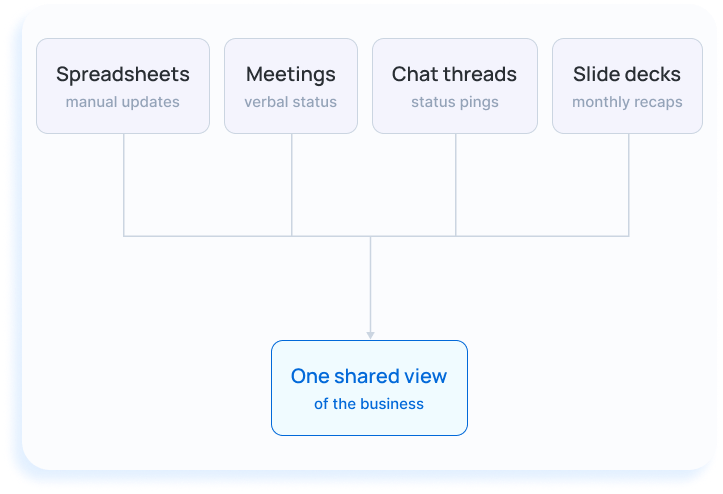
No more pulling numbers from spreadsheets, chasing status updates, or waiting for someone to translate the goal into this week's priorities. See it – before the next partner meeting, not during it.
Why consulting and advisory firms lose visibility as they grow
Consulting and advisory firms usually don't struggle because people stop doing their jobs. The problem starts when information about goals, client work, and performance gets scattered across spreadsheets, meetings, and separate tools. As the firm grows, partners can no longer keep the full picture in their heads, and management needs a clearer way to connect business goals to the work that drives them.
The challenge becomes more difficult as firms grow. Research found that 29% of -sized companies cited a lack of coordination between departments as a top internal issue while 44% cited ineffective collaboration as a significant barrier to transformation.
When your firm has 10–30 employees
Partners are still directly managing client work and internal initiatives. Goals are often set informally in meetings or emails, and accountability depends on personal follow-up. Visibility into delivery depends on partner memory and periodic check-ins. Data sits in spreadsheets and scattered documents, so partners spend time consolidating progress instead of leading.
When your firm grows to 30–75 employees
Practice leads start owning pieces of delivery that used to run through a single partner, but there's no shared system to hand that work off cleanly. Goals set at the partner level rarely make it into a practice lead's weekly priorities without someone translating them by hand. Reporting becomes a recurring task, someone pulls numbers from three or four places before every leadership meeting, rather than pulling them from one.
When your firm reaches 75–150 employees
Teams start living in disconnected tools and presentations, and performance data is scattered across multiple platforms and spreadsheets. Partners can no longer rely on intuition and need real-time information about which initiatives are moving and where bottlenecks are, to make timely decisions.
Why a basic task manager falls short for growing advisory firms
As consulting and advisory firms grow, a basic task manager that just organizes daily tasks and deadlines stops being enough. These tools don't show how individual work connects to broader business goals or key metrics. Without that connection, teams can execute tasks without understanding their impact, and management has no reliable way to tell whether task execution lines up with strategic priorities.
Simple task managers also lack a mechanism for clearly assigning responsibility for goals, processes, and results, which leaves gaps in accountability. And they give management no real-time visibility into progress, bottlenecks, or issues before they escalate.
Enforcium closes that gap by linking daily tasks directly to business goals, measurable metrics, and accountable owners, so each action ties back to a result someone is actually responsible for.
Enforcium vs. PSA software
If your firm needs time tracking, billing, invoicing, resource utilization, or project accounting, Enforcium is not a replacement for PSA software. Explore our Professional Services Automation solution for tools built around those needs.
Enforcium focuses on a different layer: connecting firm goals, metrics, processes, and accountability with daily work. It's designed to run alongside your PSA, CRM, or BI tools, giving you one operational system that links strategy to execution without overlapping financial or resource management functions.
How Enforcium connects goals, metrics, processes, and work
Enforcium replaces disparate spreadsheets, flipcharts, and task lists with one connected system where firm goals, key results, processes, and daily tasks live together. Management spends less time compiling status lists and more time making decisions.
By linking metrics directly to process steps and tasks, the system flags when critical actions are delayed or missed, giving practice leaders and partners real-time visibility to act before issues reach client outcomes or internal initiatives.
Every objective, metric, process step, and task in Enforcium has a designated owner and due date. That clarity helps managers hold teams accountable and keeps work moving toward measurable goals.
Processes are documented and linked to the metrics they affect, so execution stays consistent across projects and practices. As the firm scales, this reduces reliance on tribal knowledge and supports improvement that's directly tied to business results.
Real operational points this one system addresses
Partners spend less time updating status
Partners don't need to sit in on every conversation to know whether an initiative is moving. Enforcium gives them a live view of progress on the work that matters, without asking each team to prepare a separate update.
- See which initiatives need attention
- Cut the time spent preparing periodic status reports
- View progress without collecting individual updates one by one

Client portfolios are easier to manage
For consulting firms, performance rarely rides on a single project. Leaders need to see how multiple clients, projects, and internal priorities are moving at the same time.
- Compare progress across active projects
- Track metrics tied to client or practice outcomes
- Spot patterns in repetitive work

Repetitive management work becomes a defined operational rhythm
Many firms run the same reviews, approvals, follow-ups, and planning sessions over and over without ever turning them into a consistent process. Enforcium makes that repetitive work structured and visible: steps and deadlines get assigned before work begins, and completion is tracked instead of assumed.
- Turn recurring activities into defined processes
- Assign responsibilities and deadlines before work begins
- Track completion across recurring operational work

Meetings lead to decisions, not another round of updates
The weekly management or practice meeting should move the business forward, not reproduce information that already exists elsewhere. When work, metrics, and responsibilities are already linked, teams spend less time explaining what happened and more time deciding what comes next, reviews stay current, discussion focuses on exceptions, and agreed actions turn into tasks in the same system.
- Review current performance before the meeting
- Focus discussion on issues that need a decision
- Turn agreed actions into assigned work

Growth doesn't require another layer of coordination
Adding people usually means adding more managers, meetings, and manual coordination just to keep everyone aligned. Enforcium gives a growing firm a shared operating structure that supports more teams and processes without making partners the constant point of coordination, new leaders get clear responsibilities, expectations are visible to every team, and management practices scale with the firm instead of bottlenecking on partner time.
- Give new leaders clear responsibilities and expectations
- Keep teams aligned around shared priorities
- Scale management processes across growing teams

When consulting, HR advisory, and boutique advisory firms need Enforcium
Consulting firms often juggle multiple client projects with different goals, which makes it hard to track how daily work contributes to the firm's overall goals. Enforcium ties project outcomes to measurable metrics and defines accountability clearly, so partners and practice leaders can track progress and step in early when client outcomes or internal initiatives risk falling behind.
HR advisory firms run complex talent programs, compliance initiatives, and client assessments that need consistent execution and measurable impact. Enforcium links these processes to key metrics and sets accountability at every step, so program milestones get met and management can track progress without manual updates or fragmented spreadsheets.
Boutique consulting firms often struggle to scale past informal management as they add clients and services. Enforcium gives them a structured system where goals cascade from the firm to the engagement level, processes are standardized with linked metrics, and tasks carry clear ownership, helping boutique firms keep control as they grow.
Specialized advisory practices serve niche industries or functional areas, which can lead to siloed workflows and inconsistent performance measurement. Linking those processes to firm goals and metrics creates one framework for cross-team accountability and helps management spot and fix bottlenecks in real time.
Consulting firm scenario: From partner-led control to structured management
Imagine a 30-person consulting firm with three founding partners, several practice leads, and a mix of senior consultants and analysts. Objectives get set annually during an offsite, but by mid-year, most team members can't recall the specific targets. Reporting is manual, spreadsheets get updated only right before quarterly partner meetings.
Key operational problems
How Enforcium changes the workflow
The resulting way of working
Goals and priorities are scattered across documents and conversations, making it hard to keep teams aligned. No system tracks who owns which objective, metric, or process step. Reporting takes real manual effort to pull data from multiple sources. Partners spend too much time chasing updates, and internal initiatives keep losing ground to client work because nobody owns them or can see where they stand.
Leadership defines a clear objective – "Grow recurring advisory revenue in the financial services sector over 12 months" – and attaches measurable key results like expanding client retainers and raising average engagement value. Metrics such as client NPS and proposal hit rate link to specific process steps, like client reviews and proposal approvals.
Each process step becomes a task in Enforcium's built-in task manager, assigned to an owner with a deadline. Practice leads and consultants manage their daily work inside the system, which gives real-time visibility into progress and risk.
Partners stop collecting verbal updates and start checking live dashboards for goal progress and task status. Practice leads know exactly what they're responsible for and can get ahead of bottlenecks instead of reacting to them. Internal initiatives get defined owners and deadlines, so they move forward alongside client work instead of losing to it. Reporting is automated and consolidated, which frees up time for actual strategy discussion. The firm moves from reactive coordination to proactive management, making decisions from current data instead of intuition or scattered information.
Enforcium connects goals, metrics, and delivery accountability for consulting, HR advisory, and boutique advisory firms.
You can adopt it incrementally – start with one practice or one strategic initiative instead of replacing your entire stack.
Consulting management vs. partner-led operations
Dimension
Partner-led operations
Structured professional services management
The goal is to give the whole firm a shared operational view of its priorities, performance, and execution. Enforcium provides professional services management software for firms that need to connect strategic priorities with operational execution.
Gain clarity and control as your firm scales
Take charge of your firm's goals, delivery progress, key metrics, and accountability with a system built for consulting and advisory growth.
Frequently asked questions
Yes. Enforcium can give firms a common operating structure across practices while letting each team manage its own goals, metrics, processes, and responsibilities. Leadership can compare performance across areas without forcing every practice to operate exactly the same way.
Yes. Firms can adopt Enforcium incrementally instead of changing their whole operating model at once. A team can start with one practice, one initiative, or one set of processes and expand once the approach proves useful.
They solve different problems. PSA platforms typically handle time tracking, billing, invoicing, resource utilization, and project financials. Enforcium connects business goals, metrics, processes, and accountability with daily execution, it doesn't replace your PSA.
Enforcium gives leaders a structured view of current goals, metrics, responsibilities, and operational progress. Instead of opening a review by collecting updates, management can go straight to what needs attention, what needs deciding, and what should happen next.
Yes. Enforcium supports practice-specific processes while keeping shared goals, metrics, and accountability visible at the firm level, so teams keep working their own way where it matters without ending up on completely disconnected operating models.
Enforcium is built to run alongside the systems a firm already uses, not to replace them all at once. It's the management layer connecting goals, metrics, processes, and execution, while your existing tools keep doing what they already do well.
Business development, client retention, delivery quality, operational improvement, practice performance, and other strategic priorities, connected to measurable results, processes, and the work required to reach them.