Operations management for consulting and advisory firms
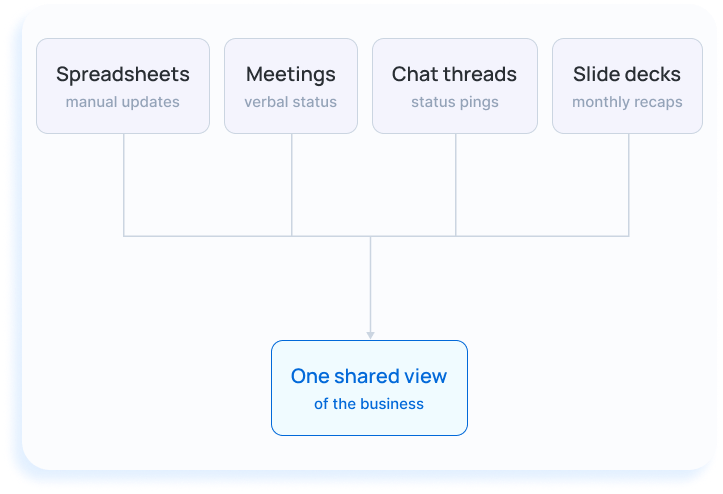
No more pulling numbers from spreadsheets, chasing status updates or translating annual goals into this week’s priorities by hand. See where the firm stands before the partner meeting, not during it.
Why consulting and advisory firms lose visibility as they grow
Consulting firms rarely struggle because people stop doing their work. They struggle because goals, client work and performance data end up in spreadsheets, meetings and separate tools. Past a certain size, partners can no longer hold the full picture in their heads.
This is a common pattern. In a Forrester Consulting survey commissioned by Airtable, 79% of more than 1,000 respondents in the US and UK said teams across their organizations are siloed, and 31% saw lower revenue as a direct result of silos, inaccurate data and broken work processes. In Lucid’s 2025 survey of more than 2,100 knowledge workers, 44% named team misalignment as a project workflow challenge.
10-30 people
Partners still run client work and internal initiatives directly. Goals are set in meetings or emails, and accountability depends on personal follow-up. Partners spend time consolidating progress instead of leading.
30-75 people
Practice leads start owning parts of delivery that used to run through one partner, but there is no shared system to hand that work over. Firm goals rarely reach a practice lead’s weekly priorities unless someone translates them by hand. Before every leadership meeting, someone pulls numbers from three or four places.
75-150 people
Teams work in separate tools and slide decks, and performance data is spread across platforms. Partners need current information on which initiatives are moving and where the bottlenecks are, and intuition is no longer enough.
Why a task manager is not enough
A task manager organizes daily work and deadlines. It does not show how that work connects to firm goals and key metrics, and it has no clear way to assign responsibility for goals, processes and results. Enforcium links daily tasks to business goals, measurable metrics and accountable owners, so each action ties back to a result someone is responsible for.
Enforcium and PSA software: different jobs
Search for professional services management software and most results are PSA tools. PSA (professional services automation) handles time tracking, billing, invoicing, utilization and project accounting. Enforcium does not replace that.
Enforcium works on a different layer: it connects firm goals, metrics, processes and accountability with daily work. It runs alongside your PSA, CRM or BI tools and does not duplicate their financial or resource functions.
How Enforcium connects goals, metrics, processes and work
Spreadsheets, whiteboards and task lists are replaced by one system where firm goals, key results, processes and daily tasks sit together. Management spends less time compiling status and more time deciding.
Metrics are linked to process steps, and each step becomes a task in the built-in task manager. When a critical action is late or missed, the metric shows it, and practice leads can act before it affects a client.
Objectives, metrics, process steps and tasks each have a named owner, and targets have deadlines. Clear ownership keeps work moving toward measurable goals.
Processes are documented and linked to the metrics they affect, so execution stays consistent across projects and practices, and the firm relies less on what a few people remember.
What changes day to day
Partners spend less time collecting updates
Partners see progress on the work that matters in a Live Dashboard, without asking each team for a separate report.
- See which initiatives need attention
- Spend less time preparing status reports
- Follow progress without collecting updates one by one

Client portfolios are easier to follow
A consulting firm’s performance rarely depends on one engagement. Leaders need to see several clients, projects and internal priorities at once.
- Compare progress across active engagements
- Track metrics tied to client or practice outcomes
- Spot patterns in repeated work

Recurring management work gets a clear rhythm
Reviews, approvals, follow-ups and planning sessions repeat every month but often never become a defined process. In Enforcium they get steps, owners and deadlines before the work starts, and completion is tracked instead of assumed.
- Turn recurring activities into defined processes
- Assign owners and deadlines up front
- Track completion of recurring work

Meetings end with decisions
When work, metrics and responsibilities are already linked, the weekly management meeting stops being a round of updates. The team reviews current numbers beforehand, discusses exceptions and turns agreed actions into tasks in the same system.
- Review performance before the meeting
- Focus on issues that need a decision
- Turn agreed actions into assigned tasks

Growth without another layer of coordination
More people usually means more meetings and manual coordination. With a shared operating structure, new leaders get clear responsibilities, expectations are visible to every team and partners stop being the bottleneck.
- Give new leaders clear responsibilities
- Keep teams aligned on shared priorities
- Scale management practices with the firm

Who it is for
Consulting firms juggle several client projects with different goals. Enforcium ties project outcomes to measurable metrics and named owners, so partners can step in early when an engagement or an internal initiative falls behind.
HR advisory firms run talent programs, compliance work and client assessments that need consistent execution. Linking these processes to metrics and owners lets management track milestones without fragmented spreadsheets.
Boutique consulting firms often outgrow informal management as they add clients and services. Goals cascade from the firm to each engagement, processes are standardized and tasks have clear owners.
Specialized advisory practices serving one industry or function often end up with siloed workflows. One framework of goals, metrics and owners makes accountability visible across teams.
Example: from partner-led control to structured management
Take a 30-person consulting firm with three founding partners, several practice leads and a mix of senior consultants and analysts. Objectives are set once a year at an offsite. By mid-year, few people remember the targets, and spreadsheets get updated only before quarterly partner meetings.
The problems
What changes in Enforcium
The result
Goals live in documents and conversations. Nobody tracks who owns which objective, metric or process step. Reporting means pulling data from several sources by hand, and internal initiatives keep losing to client work because nobody owns them.
Leadership sets an objective such as “Grow recurring advisory revenue in financial services over 12 months” with key results like more client retainers and a higher average engagement value. Metrics such as client NPS and proposal hit rate are linked to process steps like client reviews and proposal approvals. Each step becomes a task with an owner and a deadline in the built-in task manager.
Partners check the Live Dashboard instead of collecting verbal updates. Practice leads know what they own and see bottlenecks earlier. Internal initiatives get owners and deadlines and move alongside client work. Reporting comes from one place, which frees time for strategy.
This is an illustrative scenario, not a customer case study.
Partner-led vs structured operations
Partner-led operations
Structured operations with Enforcium
You can start with one practice or one strategic initiative instead of changing the whole firm at once.
FAQ
Yes. Each practice manages its own goals, metrics, processes and responsibilities within a common structure, and leadership can compare performance across practices.
Yes. You can start small, with one practice, one initiative or one set of processes, and expand once it works.
They solve different problems. PSA platforms handle time tracking, billing, invoicing, utilization and project financials. Enforcium connects goals, metrics, processes and accountability with daily work. It does not replace your PSA.
Leaders see current goals, metrics, owners and progress in one place before the meeting, so the review starts with what needs a decision rather than with collecting updates.
It runs alongside the systems you already use as the management layer that connects goals, metrics, processes and execution, and it can be connected to those systems. You do not have to replace your other tools.
Business development, client retention, delivery quality, operational improvement, practice performance and other priorities, each connected to metrics, processes and the work needed to reach them.
Get clarity and control as your firm grows
Track your firm’s goals, delivery progress, key metrics and accountability in one system. Try it free for 14 days.